Showing posts with label Japan. Show all posts

Friday, January 26, 2018

Honshu, Japan, Pt. 4

My friend in Japan is very sweet. When I told her that I was taking a Japanese course she said that her boyfriend could be my speaking partner. If he were local, then I might take her up on the offer. It would be good to have a language partner who didn't speak any English. I'd never be tempted to 'cheat' as there would be no point.

I had intended on writing a 'part 4' of my Japan trip back in autumn, but never got around to it. Now seems a good a time as any to finish that up--

Our time in Tokyo was just over two days, short but well spent. The below photo was taken at a place in the pedestrian zone of Asakusa, just a stone's throw from the temple. While walking around one night looking for a place to eat, we spied a rather full joint on a corner & my friend told me that their specialty was a kind of omelette/pancake/crepe. My interested was piqued, so we went for dinner. The server brings a bowl of uncooked cabbage with raw egg, I assume, spices, and whatever topping one wants like meat or cheese. We ordered ours with cheese. The entire contents of the bowl is poured onto a VERY hot griddle and the mixture is then sort of mixed/cut up by the server using two chopper/salad tosser-looking tools. Before our server left we were told that when the cheese is fully melted, our meal would be ready to eat. I don't know if you can see in the shot, but one is meant to eat the griddle cabbage-cake with a wee shovel (that's resting on the dish in front of me). The chop sticks were used for a fish seasoned with miso dish (out of shot) we also ordered. My face is read because it's about ten at night, the walls of the restaurant are opened to the night air, and it's still around 26C out. That huge glass of ice water was downed in no time.

Asakusa regional dish of cabbage with cheese cooked on a very, very hot griddle.


In the final days of my trip, we took a train down to the fourth largest city in Japan, Nagoya. Their main claim to fame is an astounding castle and its attendant grounds. Below is a replica of one of the two 'fish animal' creatures that adorned the top of the castle, one facing east and one facing west. They are meant to be protectors of the castle. Later, when we went on a guided tour of the grounds, we found out that they did not do their job, unfortunately.


Replica of original dolphin creature approx. 6' tall that stood atop the old castle.

Waiting at the entry gates to the castle grounds were 5 women wearing armbands, and, as it was pouring rain, holding umbrellas. They were on hand to give gratis castle tours to speakers of English. We decided to got for it. The woman, retiree with a desire to practice English, giving the tour could not have been nicer. (She had us take a picture in front of the dolphin creature replica, and to get us to smile said, 'pickles! butter!')

What we learned, in addition to the history of the different dynastic families living in Nagoya from the 17th to 20th century, was that in 1945 American forces obliterated the castle in an air raid. What one visits today is a reproduction built in the late 1950s. The origninal roof top 'guards', a sort of dolphin creature, had melted into blobs of gold during the raid. We were told by our guild that the gold was then refashioned into two massive tea pots now on display in Nagano City. The newly constructed marine creatures (you can see a speck of one of them in the below photo) are made of a slighter lesser quality of gold and are greatly reduced in size.


The rock wall withstood the bombing. All original.

Note one of the gold sea creatures atop the castle.


Tatami receiving room in Nagoya Castle

Note the black lacquer ceiling. The more ornate the ceiling, the higher status the room & its guests. 

During my stay in Japan, I was fortunate to book an appt. with my friend's hair stylist. Below is a picture of the two of us. My friend had to translate for us, but all turned out well. The young man who shampooed my hair was keen on learning English. His dream is to do hair in New York. He was so eager to practice his English with me that I think what normally takes a few minutes' time under the faucet took what felt to be about twenty minutes. He would scrub my head while asking me halting questions in English that I couldn't really hear with all the scrubbing going on. We did our best & my hair got squeaky clean. As it turned out, he has relatives here in the Bay Area. I gave him my email & told him to contact me anytime. I told him I'd be happy to show him around the city were he ever to visit. So far, he's yet to send a missive.


Lovely haircut from a lovely stylist.

Thursday, January 25, 2018

Nihongo

Kon'nichiwa!

a, i, u, e, o

I just started taking a Japanese course last week. It's a challenge, but a fun one. We're being taught both the romanji (Roman alphabet) and Hiragana (one of three alphabets used) writing systems at the outset. I've only a few short Hiragana words committed to memory. And if I had a Japanese keyboard, I'd show you! Writing the characters is like creating little, tiny pieces of art. Our Latin alphabet isn't so difficult to render, comparatively speaking. This is especially so if one is using block letters. Japanese, by contrast, looks as if it were still written by brush--there are little tales on many of the end strokes. One is meant to reproduce the characters in this way even with a pencil or pen.

Japanese sentence structure is also different from English.

English is: S-V-O or subject-verb-object.
Japanese is: S-O-V.
It also seems that word order in Japanese is less fixed than it is in English. For example, word particles sort of like our prepositions following the noun refer back to the noun, if that makes sense. It doesn't yet make a bunch of sense to me.

Bea (s) san* wa gakusei (o) desu (v). Bea (s) is (v) a student (o).

If one wants to ask if Bea is a student, then the question word 'ka' is simply tacked onto the end of the statement. That's pretty cool & not too difficult to remember.

Bea san wa gakusei desu ka?      Hai, gakusei desu. Yes, (Bea) is a student. The subject in the answer is omitted.

*san is an honorific

Anyway, it's all pretty interesting and full-on. We can already count to 100, use basic greetings & dabble in basic negations. Woot!

It's a good stretch for the old brain. I'm grateful to be there.

Thursday, September 21, 2017

Honshu, Japan Pt. 3

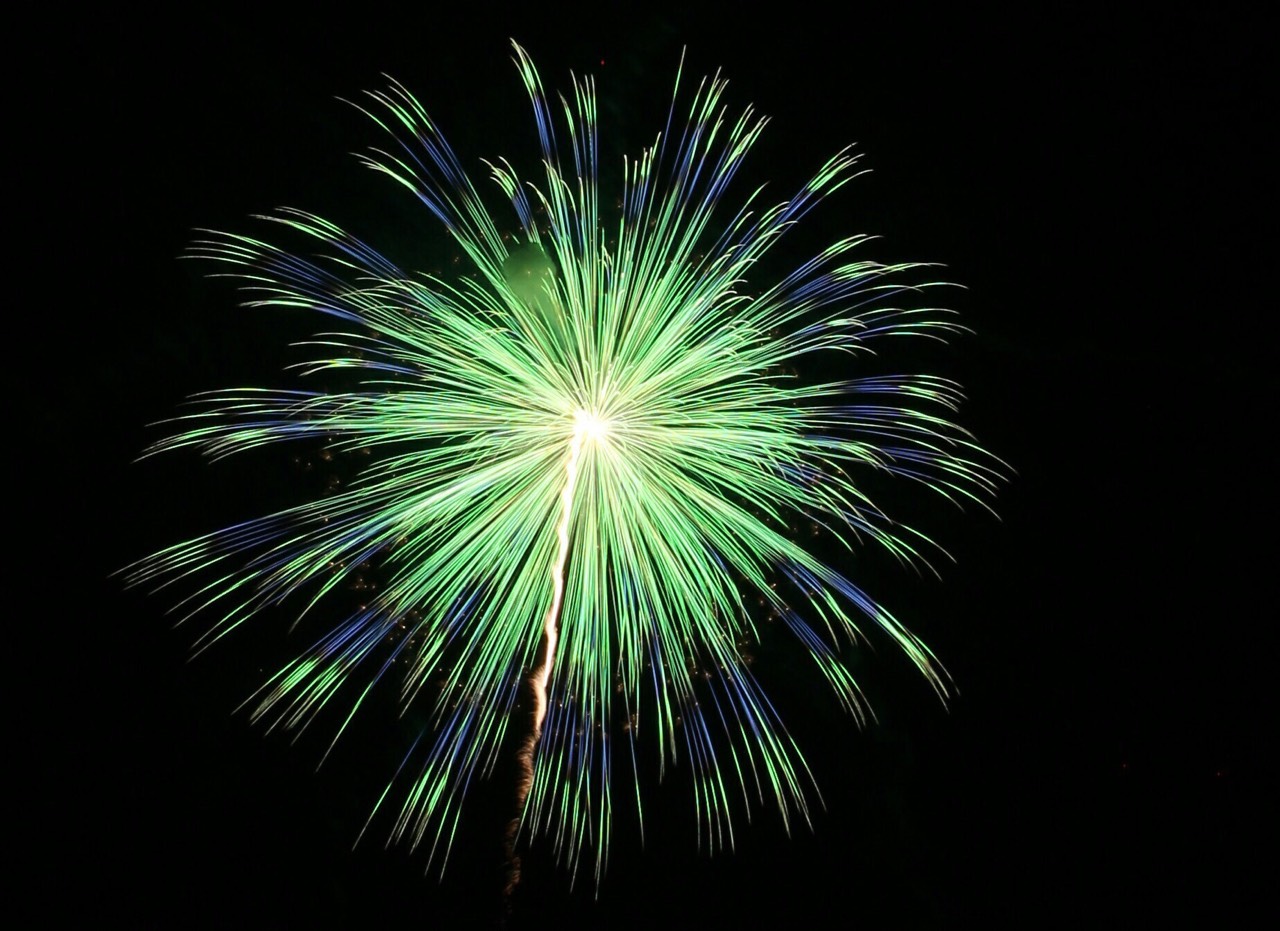
The Japanese have turned fireworks into an art form. Summer is the season of multiple fireworks displays across the country. At the beginning of this month, I was fortunate enough to have attended a fireworks competition at Suwa Lake near Matsumoto City, Nagano.

There were approximately 24 entrants, the event lasted two hours long, and each selection was introduced by a moderator. The event was flanked by impressive displays of eye-popping fireworks. The whole thing was a bit mind-blowing. We have nothing like this, as far as I know, here in the states.

My Japanese friend has a friend who is a huge fireworks enthusiast. He attends multiple fireworks events each year in Japan. The below picture is one of hundreds he took that night at the show. The picture below his is mine, taken with a mobile phone. 

Not only did I see the most amazing display of fireworks at Suwa Lake, but I also enjoyed a lovely dinner to boot. The bento box picture below shows a rather decadent meal, don't you think?

Proper photo.

Taken on my android.

Bento box included in ticket price.

Waiting for the sun to go down, Suwa Lake.


Day trip to Nagano City to visit the Zenkoji Buddhist Temple--

The temple dates back to the 7th century, but, from what I understood, this latest structure was built in the early 18th century. We walked from the rather modern & user-friendly Nagano main train station to the temple. It was a pleasant 30 minute stroll along a nice-looking boulevard. The closer we walked to the temple, the posher the shops and buildings became. The below shot is just at the entrance to the temple grounds.

Walk up the main drag to the temple.

Muscled foot of one of the guardians of the temple. He stood about 20' tall & was entirely made of cypress.

Tour group just in front of the Niomon Gate. 

Temple shot.

Advert from a local dairy on temple grounds.

Back side of temple. 
If I can find any more decent shots of the trip, then I shall post a Pt. 4!

Tuesday, September 19, 2017

Honshu, Japan Pt. 2

On one sunny day, my friend drove us (through multiple tunnels and over narrow mountain passes) to Takayama & Hida. My friend told me that Takayama is renowned for its morning market. It was lovely, but more intriguing for me was the stretch of well-preserved merchants' residences dating from between the 17th and 19th centuries found off the main drag through town. I didn't get the best shots of the merchant streets, but here are some of 'em anyway.


Entrance to merchants' area; the smaller sign reads: no smoking.


Sake and rice shop. Giant orb over door signifies sake, but I don't know why.

Wood/bamboo siding on one of the merchant buildings

We strolled through the market just before it closed at noon. We certainly aren't the only tourists to visit; many of the shopkeepers use English, both in speaking & on signage, to entice folk to their stalls. I needed no barker to help get me to the espresso stall. The proprietor roasts his own in beans, and takes great care to make a balanced, flavorful espresso. His sort of fun gimmick was serving macchiato in edible cups. I opted for paper, but my friend had the 'cookie' cup. I think she said it tasted of ice-cream cone.

Espresso in an edible cup.

Peaches that would have made Roald Dahl proud.


At the market: cukes and one lone tomato for 50 yen a piece.
Morning market welcome sign.


Red bridge, Takayama

The Hida folk village was about a 30 minute drive from Takayama. We parked well above the village & were rewarded with this view--

Hida Folk Village 


I should have put up a pencil for scale. Massive Hibiscus.


Hida Folk Village manhole cover. 

Koi in a small brook, Hida 
--more to come!

Wednesday, September 13, 2017

Honshu, Japan Pt. 1

So much happened on my trip to Japan not least of which was No. Korea sending a test missile across Hokkaido & a typhoon blowing up the eastern coast of the country. 

The test missile landed in the ocean without much fuss & the typhoon sent cool temperatures and strong winds our way, but not much else, fortunately. 

I flew into Tokyo & spent a couple of days there before taking the bus to Nagano. Once out of the city, the landscape became hilly & green. I guess I've not watched enough Japanese films because I hadn't realised that Japan was so lush. I think the country 2/3 forest. -pretty impressive when you think how densely populated Japan is.

Speaking of forest, my friend and I took a day trip to Mt. Fuji & on the way we visited Aokigahara aka the Suicide Forest. We pulled over and parked. Aokigahara didn't seem so scary, and besides there were scads of other visitors around to make the place seem very lively, indeed. As you can read, we made it out from our forest walk alive. :)

After visiting the forest, we drove to a nearby lake in order to get a gander at Mt. Fuji. The weather was a bit overcast, but the clouds kept shifting around Mt. Fuji while we stood & admired the view. I was told that the clearest views of Fuji are very early in the morning. Regardless, we were able to take a few decent shots from the side of the road (like everyone else). 


During my stay, we also visited my friend's friend's rice paddy. The paddy has long been in his family--get this--for 20 generations. I don't how one could keep intact family records so long, but that's what he said. -1,200 years of rice harvesting on this one spot. You could have knocked me over with a feather, I was a bit flabbergasted. 

Friend's friend's wee work truck.

Paddy shot w/ neighbor's house in background. And, yes, she regularly receives rice from the harvest!

The rice was to be harvested this week, actually. It would then be dried in the open air for approx. 2 weeks. A machine, I was told, would then remove the rice from its stalks. And then, I think, the rice will be ready to eat. As I understand it, drying the rice by hand results in a much sweeter product. I'd be keen to try some & find out for myself! 


Manhole cover art in Inashi, Nagano

Nagano produces many fruits and vegetables. Walking in the vicinity of my friend's flat, I saw eggplant, perilla (Japanese basil), kiwi, asparagus, grapes, parsley, and tomatoes. Directly behind my friend's place were both rice and buckwheat fields. Nagano, I found out, is famous for its buckwheat.
Soba noodle joints, unlike here in California where ramen is still the noodle du jour, prevail. I was not disappointed with the fare, to be sure! 

The below picture shows a cold soba dish with rice ball, a dish of green onion/daikon/wasabi & picked cucumber (and out of shot was a small green salad & a dish of dipping sauce for the soba, tsuyu). This soba lunch was probably the best meal I had during my stay. 


Hot soba dish with sweet soya product called Yuba aka tofu skin.

A trip to Nikko to visit the temples and shrines of the area led us to eat Yuba, a dish made of the 'skins' of cooked tofu. The above picture shows a soba soup with Yuba as its centerpiece. All of it was delicious. 


On the grounds of the Nikko shrine site.

One of many temples on site. 

We spied a bridge on the walk back to the Nikko train station.

Once I upload more pictures to the computer, I'll post a bit more about the trip! 

Today

I am unable to comment on posts, at present, and that feels weird. Delighful-looking crab-apple jelly, beautiful Dahlias in NZ...all these l...