Showing posts with label Geschichte. Show all posts

Tuesday, May 28, 2019

A taste of Italy via the Schwabenland

My dear friend, Mrs. Rempfer, a Stuttgarterin who had a passion for Italy, was given this recipe for cantuccini by an Italian friend of hers some years ago. During one of my visits to see Mrs. Rempfer, she and I made cantuccini together. I thought they were incredibly good, so she graciously gave me the recipe. In the intervening years, I think I've made them a good dozen times, or so. If you're keen, here's the recipe:


Cantuccini


300g flour
150-180g vanilla sugar
1tsp. baking powder
150g nuts (Many folk seem to prefer almonds, but I'm a fan of hazelnuts.)
2-3 egg whites
30g butter

Mix together all dry ingredients in bowl (minus the nuts), then add the butter.  I tend to use my fingers to integrate butter as best I can before adding the egg whites.  Use a spoon to mix together, then add the nuts.  By this point I've set the spoon aside and am again using my fingers to try and distribute nuts throughout the dough.

A nice accompaniment to coffee.  Bene!

Divide dough in half and roll out with one's hands into two, long portions approx. 2cm thick.  Place on baking tray lined with parchment paper and bake for 30 minutes at 200C.  Remove from oven and let cool a bit before slicing into 1-2cm pieces.  I prefer a slightly 'chunkier' biscuit, but it's really up to the individual.  Return cantuccini to the oven and bake for an additional 10-15 minutes until golden brown.

Saturday, May 11, 2019

In the office--

The big news of the week really isn't, to be honest. Twenty years ago, I was gifted a Danish desk a la mid-century design by my cousin. Recently, he asked me if I were 'still using' the desk. I took that to mean that he wanted it back, so I gave it to him. As a result, the office is a pile of papers and other miscellany. 

Here's a small sampling of stuff now littering the office floor that I've been holding onto since even before acquiring the desk. I perhaps should just either toss this stuff out or put it in a manilla envelope (and leave it on the office floor). 


A zinger from Dad

I haven't looked at clippings of my father's letters to the editor since putting together a memory book dedicated to him back in 2003. Reading this snippet from him now, I think I'm seeing that my Dad, a life-long Democrat, may have been becoming a bit more conservative in mid-life. I have never thought of my father as either a hardcore patriot or a prude, but maybe he was becoming one or both?  


My friend's father, fondly known as Der Meister (to be read in a Schwäbisch accent), was an accomplished artist. He trained as a silver engraver, but was also an adept painter, a sculptor and he could carve a mean woodcut. The above image shows one of his many designs he and his wife had printed up for their annual holiday card. The inside of this particular card includes a poem by Hölderlin (noted Schwabe) & heartfelt season's greetings. I so loved receiving these cards.

Der Meister: Selbstportrait (culled from the internet)

Der Meister was in art school when he was conscripted into the German army in 1940. He was put to work as a stretcher bearer on the Western Front. He'd kept a diary during that time filled with sketches and poems. I was lucky enough to view it once two decades ago when der Meister was still living. One page particularly struck me as it contained both a rendering of and an ode to his worn combat boots. 

Ritter, Tod und Teufel

Showing a picture of this postcard depicting one of the most detailed engravings by Dürer I have ever seen is almost an affront to the piece. I can guess as to what the symbols of both skull and hourglass reference, but as someone who knows very little about Christianity, I can't say I understand the piece in any fundatmental way. Apparently, the subject/s of this piece have been hotly debated for centuries. Dürer postcards in American art museums usually consist of his rhino and hare images. I caught a Dürer retrospective in Frankfurt some years back, so there happened to be a fine selection Dürer postcards in the gift shop to choose from. I still marvel at this work.

Friday, December 28, 2018

Memory and remembrance

Thursday's crossword was a wash. I knew the answer to only one, lousy clue. It was something having to do with Norma Rae the 1979 film starring Sally Field. I can usually be counted on to know a random film factoid. This knowledge made me especially good at answering all the pink cards in Trivial Pursuit. 


My dear friend Mrs. R has been on my mind the past couple of days. She died four years ago this upcoming January. I spoke to her last in December 2014 when I was in the middle of preparing to move back to the states from Zurich. I had rung her again on the 26th hoping to hear how she had spent Christmas and, for the first time in our 17 year friendship, not only did she not pick up, but also her answering machine didn't click on. I eventually got hold of her neighbor, a woman with whom I was friendly, and was told what I had feared: Mrs. R had recently entered into hospice and died. That was very hard to hear, but not entirely unexpected. She'd been unwell for some months. 

The last time I saw my friend, in May 2014, I could see she had greatly slowed down and come to rely ever more on her daughter for help. Still, her mind was fit & her humor intact. 

I was just looking at an old hotmail account and wondering why in the heck I still had it when I got the bright idea to look at all the images sent to said acount. I'm glad that I did because I found this picture---

A chance meeting in DE: Mrs. R and my bar pal from California

On the face of it, the above shot doesn't seem remarkable, but it is. In 2005, I had taken my yearly autumn trip to Stuttgart to visit Mrs. R. She and I were on the DB platform, having just visited a village flower show some 50 km away, when I spied a man I knew from back home. He was a regular at the bar where I worked in Berkeley. What were the odds we'd both be in 'small town' Southwest Germany at the same time? We three wound up taking the train to Stuttgart together, chatting all the way. 

Mrs. R was a teenager when the war started. After allied forces nearly bombed out Stuttgart, she and her 7 younger siblings were sent south to the countryside to sit out the war. Fortunately, as she had said, she and her siblings found themselves in the American sector. The soldiers were friendly and would ply the kids with chocolate. She once told me of how an American soldier took a shine to her three-year-old brother. The soldier expressed a desire to take the brother back to America and adopt him. This was not at all on the cards, but I guess the soldier was fairly adamant. It got to the point where Mrs. R kept her baby brother indoors when that particular soldier would come around. She also told me that the soldiers would often be outside 'playing ball' with tins of food. After one such game, one of the siblings noticed that the tin doubling as a ball had been left behind. He pinched it, bringing it back to the house. I will never forget Mrs. R's face as she described the thrill she and her siblings felt when the tin was opened to reveal chunks of pineapple! None of them had ever eaten anything so exotic. What a treat that pineapple must have been to them. 

The story of how Mrs. R and I met is a bit long and convoluted, so, please, bear with me. Mrs. R was the friend of a friend of an American acquaintance of mine I had made in the exchange program at the University of Tübingen. We bothed lived in the same dormitory and hung out loads together after classes. Unlike the rest of us foreign students, my dorm buddy happened to have a family friend living in the neighboring village of Wurmlingen. The family friend was a very welcoming sort and I usually got to tag along on outings to her place. My dorm mate's Uncle Geoffrey had been stationed in Germany after the war. During his time in Baden-Württemberg, her Uncle Geoff had been quartered by an artist and his wife, a former Red Cross nurse. Their daughter was the woman whom my dorm pal and I visited regularly just down the road from Tübingen. Mrs. R had been a neighbor of the artist and his wife and knew Geoffrey as well.  

During one of our village visits, Mrs. R rang the house and found out that the American soldier's niece was currently studying in Germany. Mrs. R invited us both (I think she was being polite) to Stuttgart for the afternoon. We set a date. On the day in question, my friend flaked out, so I headed to Stuttgart via train on my own. Mrs. R, as she would come to do in the intervening years, met me at the Hauptbahnhof. We took the tram back to her place for a lovely meal and a chat. My German was still fairly rough at that point and Mrs. R was very forgiving. That afternoon marked the beginning of our friendship. 

She and I spoke formally, per Sie, for the first ten years of our relationship until Mrs. R invited me to use 'Du'. We toasted the change in language with a white wine at hers. Even with the switch to 'Du', I felt most comfortable referring to her by surname. 

I remember when the film Das Leben des Anderen came out. It seemed to be a seminal film in German cinema. It was both beautifully shot and acted. She'd seen it as well and was less impressed. The film's protagonist, a Stasi officer, was protrayed as having had a heart of gold, to put it simply. Mrs. R didn't buy it. She told me that there was no way a Stasi officer would have been so empathetic. I think she referred to it as a 'Hollywood film'. She was probably right, to be honest. 

Although her life's trajectory had been knocked about by war--she'd had to quit school & watch after her siblings as a result of the evacuation--she was never bitter. She'd often say: 'What we Germans did...I don't ever dare complain.' The total capitulation and subsequent divvying up of Germany by the allied countries was talked about with a 'we deserved it' matter-of-factness. 

Mrs. R loved Bach and Barbra Streisand. She began learning Italian while in her 50s and regularly took solo trips to Pulgia. Her potato salad was tops as were her Maultaschen. She was a thoughtful person who could also be a bit cheeky. She liked to have a laugh. One of the last meals we had together when she was still ambulatory was at a pizzeria near her flat. We drank loads of red wine, eat pizza margherita and nearly shut the place down we stayed so long. I was lucky to have had her in my life for as long as I did. 

Here's a shot of us from around 2010-- 


Wednesday, December 6, 2017

Mental Map

When I was a study-abroad-student in Germany some twenty years ago, I took a German culture class. One of our student exercises was to create what the teacher called a 'mental map' of Germany based solely on what we thought we knew about the place. We were discouraged from attempting to draw an accurate map with city and state boundaries, but instead were told to focus on illustrating our preconceived notions & ideas. Most of the students created maps that included drawings of sausages and huge glasses of beer.

Our teacher, on the other hand, was a 68er & had come of age during a time of great political and social upheaval. Her map included the RAF, not to be confused with the Royal Air Force, a Swastika, and the former DDR replete with a drawing of a wee Trabbi.

Demo in Hamburg, 1968. 
Trabant

A couple of years back, I found myself at an art show at the Oakland Museum of California. There was a gal there selling prints of her watercolors and oils. I was particularly taken with her rendering of Australia, a country where my English ancestors moved to before coming out to California in the 1910s. The Australia piece was meant as a gift for her mother who hails from Australia and contains all the things that her mother holds dear about the place in which she grew up. I thought it looked like a 'mental map' of sorts and was immediately reminded of the exercise from 20 years prior. I bought the print.
Here it is--


I just spent about 3 minutes, and it shows, on drawing a mental map of my homestate of California. Don't laugh! (Well, not too loudly...)


If you're up for the challenge, then I'd be keen to see what sort of mental maps you all could come up with regarding where you're from or where you live now. Nothing is out-of-bounds save for a lack of imagination. :)

Sunday, March 5, 2017

My SF History Day

When I went to the San Francisco History Days event at the Old SF Mint Building on 5th & Mission this morning, I didn't for a second think I'd be asking a most delightful 83-year-old woman at the Visitacion Valley information booth, Cris, if she knew my Uncle Buddy had been gay. 'Oh, we ALL knew he was gay!' She then went on to say that at that time they didn't use the word 'gay'. Cris told me, too, that she'd been a late-bloomer. -that she'd always had her head in books. She thinks that is probably why Buddy asked her out. She was a safe bet.

She also related a factually inaccurate story of my family that involved Buddy's father, William Larkin. Papa Larkin, hailing from somewhere in Ireland, had been a bit of a ne'er-do-well. -couldn't hold down a job, liked the drink, and raised his hand on more than one occasion to my nana. In a rather bold move, nana divorced William & moved on with her life. This would have been the mid-1930s. With two kids in tow, life couldn't have been terribly easy. Fortunately, she had her sisters around for support. But back to William...

Cris told me that William had killed himself by hanging & wasn't that awful? I told her that, actually, William had fallen into the San Francisco Bay and drowned. He had likely been drunk at the time. -least that's what I had always heard growing up.  I called my mom later to relay the meeting with Cris. When we got to the part about the hanging, she said: No, it wasn't Buddy's father, but rather the neighbor across the street that had hung himself. It's interesting what folk remember & how they remember. Grisly stories like a neighborhood suicide tend to stick in some way, I guess.

Until today, I didn't know that the San Francisco Public Library had an arm dedicated to the preservation of SF history. I dropped by their booth at SF History Days to peruse their wares. They had a smattering of SF high school year books (none that my family, to my knowledge, were in) from various different decades. More interesting though, were the three SF directories (the Yellow Pages of their time) on hand. One was from the late 19th century; two were from the years before and after the earthquake of 1906. At that time, two of four sets of great-grandparents were living here. I figured I'd look them up. I found great-grandpa Axel in both the '05 & '07 directories. That was a fun discovery. Prior to his living on Andover St., I hadn't realized Axel had been elsewhere in Bernal Heights & also down in the Mission. You don't know what you can no longer ask of anyone. My 80-year-old Uncle is sort of the last in line. Fortunately, he's keen to chat on all things family history. A phone call to him is in order.

San Francisco Directory, 1905. Sweden represent!


The Bernal Heights History booth was staffed by wonderfully enthusiastic Bernal lovers. I spoke with one woman who is a passionate researcher of Bernal lore. I left her my email address, so that she may mail me any information she might find regarding the Hallstroms, my paternal grandmother's Swedish immigrant parents. I took her card in order to send her turn-of-the-last-century photos depicting the house on Andover St. & snaps of the family.


When the Old SF Mint was new.

The three and a half hours spent at the Mint really flew by & I'm so glad I went.

Monday, December 19, 2016

German club meeting with a bit of history.

We met this month for our regularly scheduled German language Treff. It was our first since coming face-to-face with the young, confused right-extremist kid, M., back in November. 'Keyboard warrior' that he was, I didn't really think he'd come 'round to yell at us for not taking his praise of Putin, 'hero of the European and Christian people', seriously. Still, I wasn't feeling too sure of myself, so I asked the hubs to come along with me this meet-up for moral, and, perhaps, physical support. A couple of other group regulars told me today that they would have 'up and left' had M. shown his face. Who could blame them?

The group was fairly large this time around. We were again a mix of regulars and a few new-comers. One of them was W., an 85-year-old German man who'd emigrated from Nuremberg in 1953. He was a young teen when Allied forces nearly destroyed the city. W. spoke in a slightly hurried fashion, his fränkisch-inflected German sometimes hard to follow. During the raids, his family hid in the bomb shelter in the basement of their building. He also made clear that the bombs being dropped were 'fire bombs'. At one point during the onslaught, the building next to his was completely destroyed. W. told me his father died in '44, but he didn't say how. During the funeral, casualties from the bombings were being brought into the cemetery. He told me of seeing a dead boy about his own age. Face frozen in shock & arms raised, the teenager's body had already undergone rigor mortis. 'I'll never forget it'. He also said to me that he had no idea why he was spared. I ventured with 'reines Glück' and he nodded.

W. heard a bit of what had transpired at the last meet-up with respect to M., the right extremist in water wings. His response was, and I'm paraphrasing, 'I give everyone the benefit of the doubt, and only after they prove themselves to be unworthy do I tell them to get lost.'

-sounds good to me, W., sounds good to me.

Sunday, November 20, 2016

Trip to DE & CH

The hubs and I took a brief trip to Europe the week of the US elections. However, given that the news outlets in Germany are on top of broadcasting about world events, we could not avoid hearing & reading about the Trump win. Donald's mug adorned nearly every magazine & newspaper cover in Germany & German Switzerland. It was off-putting to see him 'round every corner, to say the least.


'How dangerous is the new president?'

Highlights of the trip were jaunts to Basel, Konstanz & Zürich. Here are a few select photos--


Altstadt, Konstanz

Am Bodensee with friends.

Konstanz, as the Bodensee meets the Rhein

Along the Limmat, Zürich, Switzerland

Limmat, Zürich

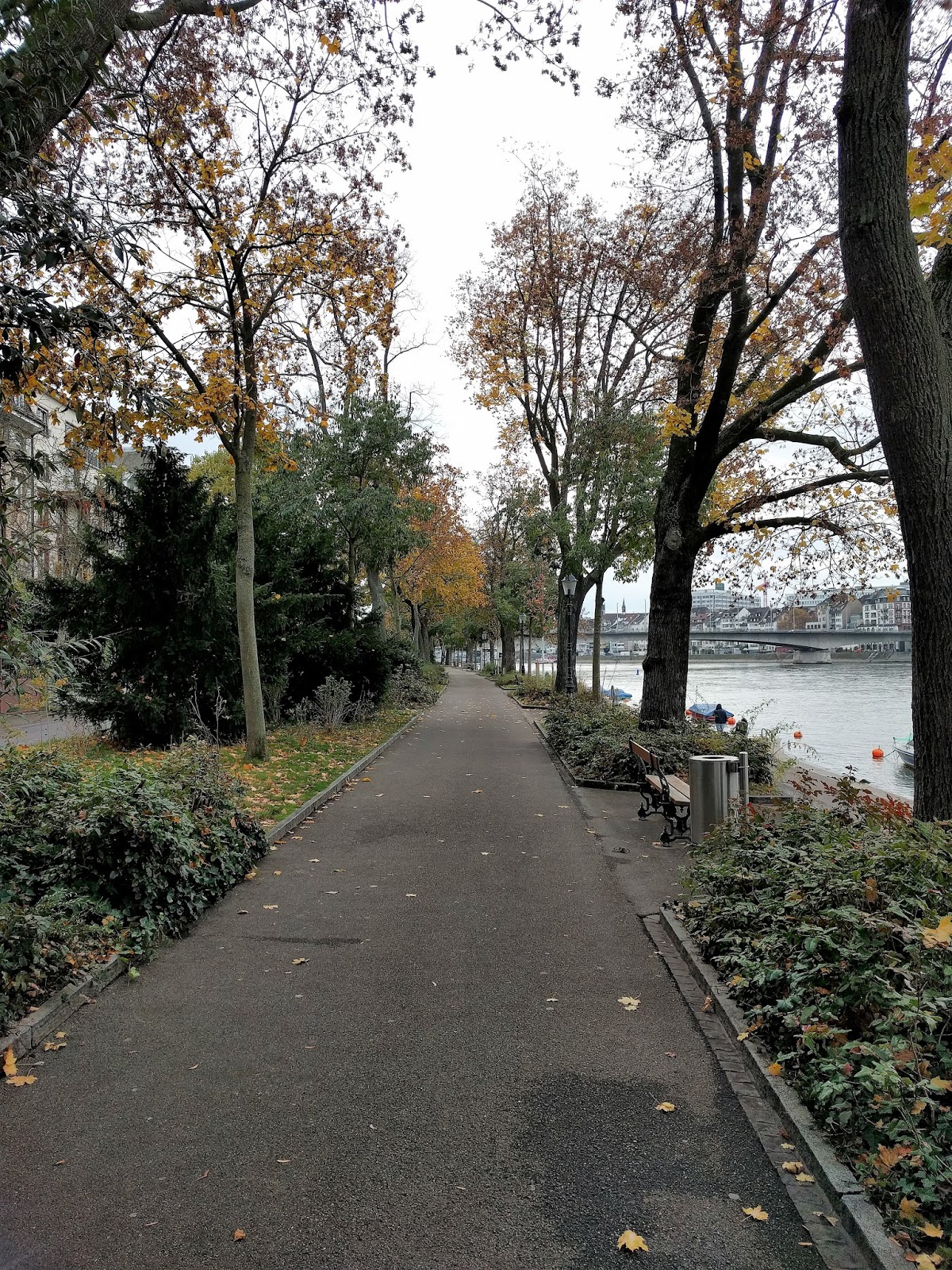
Stroll along the Rhein, Basel

Gulls along the Rhein, Basel


En route to the Botanic Garden, Basel
Altstadt, Basel
Picked up this lively print while in Basel

Checking out walking sticks at a charity shop in Basel

.
Yours truly on the Red Arrow Churchill from Zürich to Schaffhausen


I miss our life in Europe & would hope to return to live there, but, at present, a move does not seem feasible. Would that it were...!

Saturday, November 19, 2016

Das Hinterhaus revisited.

Ich lese gerade ein Buch, das ich neulich in Deutschland gekauft habe, von Journalistin und Autorin, Mirjam Pressler, die einen erweiterten Blick über die Lage der Familie Frank während des Dritten Reiches wirft. Das Buch 'ich sehne mich so' Die Lebensgeschichte der Anne Frank wurde erst 1992 in Deutschland veröffentlicht. Ob es eine englische Version gibt, bin ich mir nicht sicher.


Annes geteiltes Zimmer mit Herrn Pfeffer

Wir haben vermutlich in der Schule 'The Diary of Anne Frank' lesen müssen. Entweder damals in der Schule oder erst nachher, habe ich die Geschichte gelesen, aber das war schon eine Weile her. Mir wird nur das Oberflächliche über Anne Frank und ihre Familie im Kopf noch übrig.

Fakten: Anne und ihre Familie haben während des zweiten Weltkriegs in Amsterdam untertauchen müssen. Die Familie ist endlich von jemandem verraten worden und die Familie wurde von den Nazis erwischt. Nur Otto Frank, Annes Vater, hat die KZ-Zeit überlebt. Nach einigen Jahren hat Otto Frank erlaubt, dass Annes Tagebuch veröffentlicht wurde.

Vor ein paar Jahren habe ich in der Zeitung gelesen, dass die Geschichte, die Otto Frank publizieren liess, sei eine abgekürzte Version. Er wolle nicht unbedingt haben, dass die intimen Ausschnitte von Anne ein Publikum bekämen.

Pressler untersucht einige Nuancen der Geschichte. Annes Eltern kommen mir als völlig verwirklichte Menschen vor, die mit Schwach -und Starkpünkten (wie wir allen) geprägt waren. Ich erfahre, dass Otto und Edith Frank ein ganzes Jahr auf das Untertauchen vorbereitet haben. Wie haben sie vor ihren Töchtern die Pläne geheim gehalten? Leicht wäre das bestimmt nicht gewesen.

Die Familie Frank, die Familie van Pels und Fritz Pfeffer, ein Bekannte von denen, lebten zusammen im Hinterhaus zwei jahrelang, bevor sie verraten worden sind. Geholfen waren die Versteckte von sechs Niederländern. Eine von denen hiess Miep Gies. Mieps Erinnerungen werden oft in diesem Buch erwähnt. Ihre Erinnerungen helfen dem Leser teilweise verstehen, wie die Versteckte miteinander umgegangen sind.

Otto Franks Familie hat seit dem 16. Jahrhundert in Frankfurt gelebt. Sein Vater war erfolgreicher Kaufmann. Wie Otto stamm Edith auch aus einer wohlhabenden Familie in Deutschland. Vom Buch bekomme ich den Eindruck, dass Edith eine 'proper lady' waren. -gut erzogen, gut benehmend. Trotz guter Erziehung und genau weil die Bedingungen im Hinterhaus ziemlich unglücklich waren, hat Edith sich erlaubt, schlecht über Frau van Pels zu reden. So etwas wissen wir nur wegen Mieps Aussage. Miep hat mitgeteilt, wie schwierig es für Frau Frank gewesen sein müsse, wenn sie sich über anderen beklagen könne.

Anne war ein Mädchen wie so viele andere, die unter den Nazis ihr Leben sinnlos verloren hat. Nur weil Annes Tagebuch von Miep gehalten wurde, werden wir Leser heutzutage erlaubt, einen genaueren Blick auf ein normales Leben zu bekommen, das unter nicht normalen Bedingungen geführt wurde. Für diesen Blick bin ich Miep Gies und Otto Frank sehr dankbar. Für Presslers Buch bin auch extrem dankbar.

No on G, car show and flowers.

After campaigning fairly regularly for the past month to Save Sunset Dunes park, I've learned that some surfers are, in essense, NIMBYs ...